Case Study: Enhancing Network Resilience with Starlink & Palo Alto SD-WAN
- MediaTeam
- August 11, 2026
- Immersive Technology
- 0
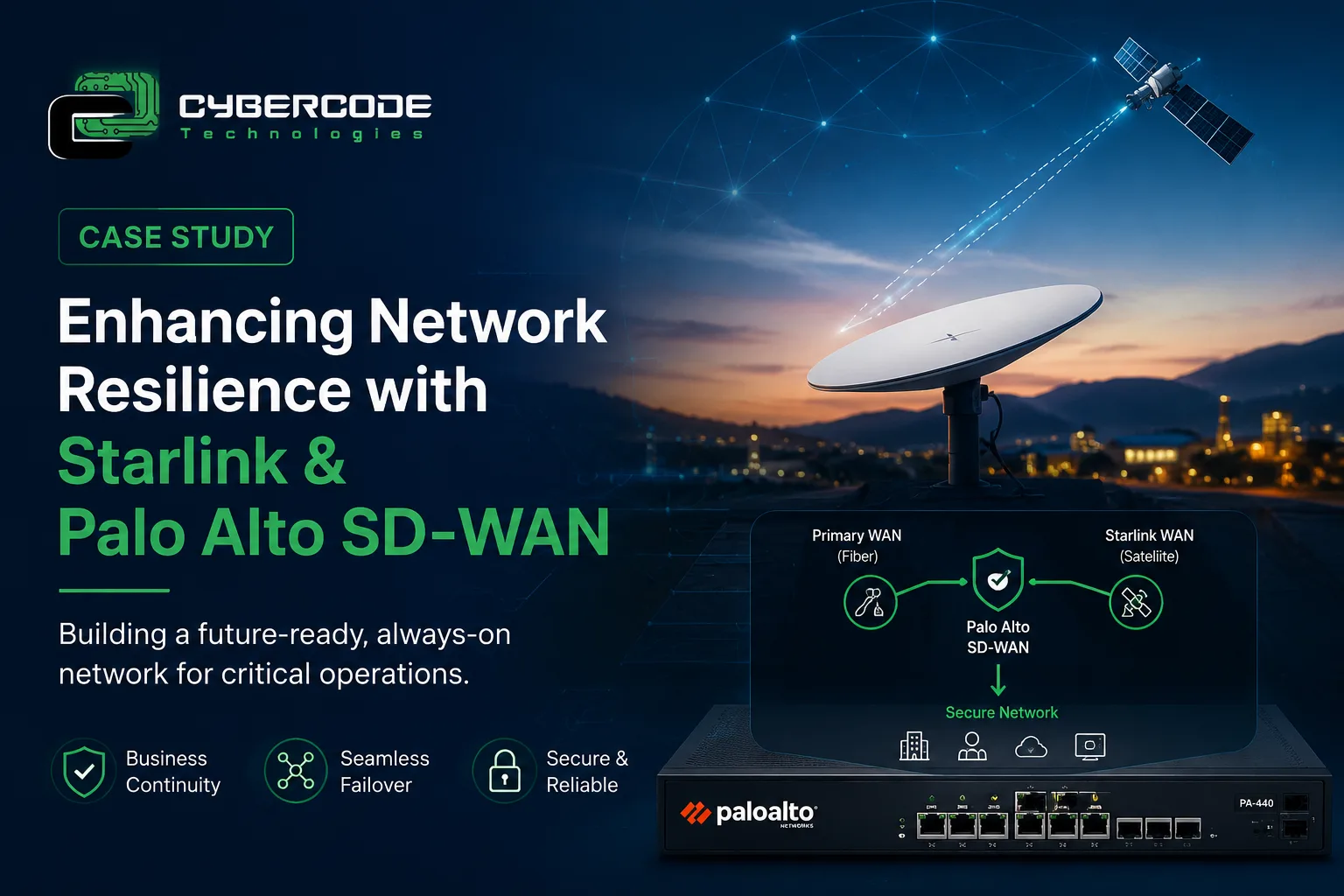


For organizations operating across distributed and regional facilities, internet connectivity is a critical part of daily operations. A single network outage can interrupt communications, disrupt research activities, limit access to essential systems, and significantly affect productivity.
This case study explores how combining Starlink satellite connectivity with Palo Alto Networks SD-WAN created a resilient secondary connectivity architecture designed to maintain operations when primary terrestrial internet services become unavailable.
Technology Services & Distributed Operational Centers
Several critical regional facilities were experiencing frequent and prolonged internet disruptions caused by vulnerabilities in local connectivity infrastructure.
The primary causes included:
Because these locations depended heavily on continuous internet access, connectivity failures could bring essential daily operations to a halt.
Research activities could be interrupted, communications between locations could be lost, and employees could temporarily lose access to critical digital resources.
In some cases, outages could last for up to 48 hours, making connectivity resilience a significant business continuity requirement.
Before implementing the new architecture, the affected locations primarily depended on a single terrestrial internet connection, such as fiber or broadband.
There was no independent secondary path capable of maintaining connectivity when the primary infrastructure failed.
This created a significant single point of failure.
When a physical fiber cut or carrier-related disruption occurred, the affected location could remain completely offline until the telecommunications provider restored the connection.
A more resilient approach required not only a backup internet service, but a physically diverse connectivity path capable of operating independently from local terrestrial infrastructure.
Starlink was selected as the secondary connectivity option because its Low-Earth Orbit (LEO) satellite network provides a fundamentally different transport path from traditional terrestrial connectivity.
Unlike fiber or other land-based infrastructure, satellite connectivity does not depend on the same local underground cabling.
This creates valuable infrastructure diversity when the primary connection is affected by fiber cuts or other local terrestrial failures.
Starlink therefore provided three important characteristics for the backup architecture:
Physical Diversity
The secondary connection uses satellite infrastructure rather than relying on the same terrestrial path as the primary service.
Geographic Flexibility
Satellite connectivity can provide an alternative option for regional or remote facilities where deploying an additional reliable terrestrial connection may be difficult.
Business Continuity
The connection can serve as an alternative transport path when primary infrastructure becomes unavailable.
However, having a secondary connection alone was not enough. The network also needed to detect problems and automatically decide when traffic should move to the backup path.
Starlink was integrated as a secondary active/passive WAN interface within the Palo Alto Networks firewall environment using SD-WAN (Software-Defined Wide Area Network) technology.
The architecture can be represented as:
Primary Terrestrial Connection → Palo Alto SD-WAN → Starlink Secondary Connection
Rather than waiting for users or local IT staff to report a complete outage, the SD-WAN engine continuously evaluates the health and performance of the primary connection.
Key network indicators include:
These metrics allow the network to identify not only a complete connectivity failure, but also situations where the quality of the primary connection falls below defined performance thresholds.
When the primary terrestrial connection becomes unavailable or degrades beyond configured thresholds, the Palo Alto SD-WAN environment can automatically redirect corporate traffic through the Starlink secondary connection.
This removes the need for local employees to manually change connections or wait for IT teams to reconfigure network routing.
Once the primary connection becomes stable again, traffic can return according to the configured SD-WAN policies.
The result is a more adaptive connectivity architecture capable of responding automatically to changing network conditions.
One of the most significant improvements was reducing the need for manual intervention during connectivity incidents.
The transition between primary and secondary connectivity can occur automatically according to predefined network policies.
This means fewer support tickets, fewer manual configuration changes, and less dependency on local staff during outages.
The architecture combines two fundamentally different connectivity methods:
Terrestrial Fiber/Broadband + LEO Satellite Connectivity
This provides stronger infrastructure diversity than relying entirely on multiple terrestrial services that may still share common local infrastructure.
If a physical issue affects the terrestrial network, the satellite path can remain available as an independent connectivity option.
Maintaining secondary connectivity helps protect critical operations from extended carrier disruptions.
Daily operations, communications, research activities, and access to digital systems can continue while the primary provider works to restore its infrastructure.
This is particularly important for facilities where outages may otherwise continue for hours or even days.
The architecture also improves visibility into network performance.
IT leadership can continuously monitor the health of both primary and secondary WAN connections using metrics such as:
Instead of evaluating network reliability only after users report problems, teams gain continuous insight into connectivity performance across deployed locations.
The deployment also established a framework for determining where additional backup connectivity should be prioritized.
Rather than deploying secondary connections indiscriminately, network monitoring data can identify locations experiencing recurring connectivity issues.
For example, locations averaging two or more outages per month can be prioritized for further redundancy.
This transforms network resilience from a reactive process into a more measurable, data-driven infrastructure strategy.
The SD-WAN architecture enables rapid transition from the primary terrestrial connection to Starlink when predefined failure or performance conditions are detected.
This minimizes the disruption experienced by users and helps maintain access to essential devices, systems, data, and communications.
The architecture significantly reduces exposure to recurring extended connectivity disruptions, including outages that previously had the potential to last up to 48 hours at initial target locations such as Overton and Beaumont.
IT teams gained continuous visibility into the health and performance of both primary and secondary connectivity paths, improving troubleshooting and long-term infrastructure planning.
Automated SD-WAN policies reduce the need for local employees or IT teams to manually switch connectivity paths when primary infrastructure fails.
The key outcome of this deployment goes beyond simply adding a second internet connection.
A backup connection provides limited value if it depends on manual intervention or shares the same infrastructure vulnerabilities as the primary connection.
By combining Starlink’s LEO satellite connectivity with Palo Alto Networks SD-WAN, the architecture introduces both physical connectivity diversity and intelligent traffic management.
The result is a network environment capable of continuously monitoring connectivity conditions, automatically responding to failures, maintaining essential business operations, and providing IT teams with the data needed to make better infrastructure decisions.
For distributed organizations and remote operational environments, this approach demonstrates how satellite connectivity and SD-WAN can work together to transform traditional backup connectivity into a more resilient and automated business continuity architecture.